Why Canadians Are Switching to IPTV: What the CRTC Data Shows
Why are Canadians switching to IPTV and other internet TV? The CRTC's 2023-2024 broadcasting report points to cost and flexibility. Subscribers to cable, satellite and operator IPTV packages fell by an average of 3% a year from 2020 to 2024, and the share of streaming-only households rose from 23% to 29% between 2023 and 2024, according to MTM survey data the CRTC cites. Households now spend more each month on online services than on TV packages.

This article belongs to our complete guide to IPTV in Canada. We sell IPTV, so we are not neutral; every figure below comes from the regulator's report or the operators' own pages, and our own offer is on the IG IPTV Canada page for you to judge separately.
What does the CRTC data say about cord cutting in Canada?
The CRTC's Communications Market Report for the 2023-2024 broadcast year, which ended August 31, 2024, describes a steady move away from traditional TV packages. It does not say everyone is leaving: subscriber numbers fell gradually, and some households moved to cheaper packages rather than cancelling.
| What the CRTC reports | Figure | Period |
|---|---|---|
| Subscribers to TV distributors (cable, satellite, operator IPTV) | Down 3% a year on average | 2020 to 2024 |
| Revenue of TV distributors | Down 5.6% a year on average; down 7.99% in 2024 alone | 2020 to 2024 |
| Streaming-only households (MTM data cited by the CRTC) | 23% to 29% | 2023 to 2024 |
| Canadians who changed or cancelled their TV package (MTM data) | Nearly 30% | 2024 |
| Average yearly revenue per TV subscriber | $791.7 to $711.9 | 2020 to 2024 |
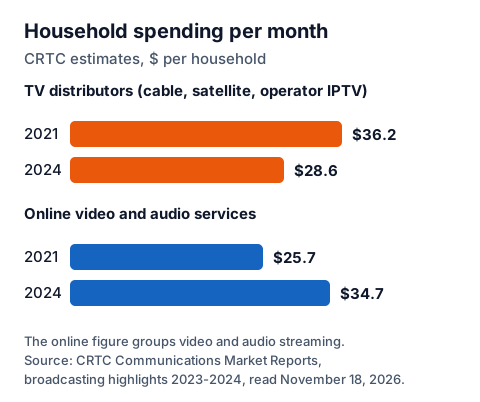
The spending figures show the shift most clearly. The CRTC estimates that average household spending on TV distributors fell from $36.2 a month in 2021 to $28.6 in 2024, while spending on online services rose from $25.7 to $34.7. The CRTC's online figure groups video and audio streaming services together, so it is not all television, but the direction is clear: by 2024 the online side was the larger of the two.
Are Canadians switching to IPTV subscriptions, or to streaming?
Mostly to streaming services, as far as the regulator's figures show. The CRTC counts operator IPTV, such as Bell Fibe and Telus Optik TV, inside the TV distributor figures, and puts services such as Netflix and Crave in a separate online category. No CRTC figure we read counts subscriptions sold by online IPTV sellers.
That matters for how you read the trend. In its 2019-2020 report, the CRTC said operator IPTV was the only kind of TV distribution still growing its revenue, by 1.2% that year, while cable revenue fell 4.4%. By 2024, the whole distributor group, operator IPTV included, was shrinking.
The CRTC also notes that newer households are choosing not to sign up for a TV package at all, in favour of "more flexible and sometimes cheaper alternatives" from online services. An IPTV subscription from a seller is one of those alternatives, but the report does not measure it, and we do not invent a number for it. If you are new to the terms, our beginner's guide to what IPTV is in Canada explains the difference between operator IPTV and a seller's login.
How much does cost drive the switch?
Cost is the reason the CRTC points to most directly. It says most Canadians with a TV package pay between $50 and $100 a month, and links falling revenue per subscriber to customers moving to lower-priced packages and to promotional TV and internet bundles.
The operators' own pages show how a package price builds up. On November 18, 2026:
- Rogers listed TV-only packages at $24.99, $80 and $125 a month for up to 35, 120 and 170 channels, each with a $10 monthly Entertainment Box and a $10 monthly Gateway on top.
- Bell listed fibre internet plus Fibe TV from $100 a month, with a 2-year Internet & TV term and an Autopay credit.
An IPTV subscription from a seller is priced differently: IG IPTV Canada costs CA$25 for one month, CA$39 for three, CA$55 for six and CA$95 for twelve months plus two free, with no box rental, and your internet bill is separate. Our IPTV vs cable cost comparison for Canada works through a full year at the listed prices.
What else pushes households to switch?
Three things beyond price come up in the operators' own offers and in the CRTC's reading of the market: devices, terms and choice.
- Devices. Bell now says Fibe TV "no longer requires a set-top box" and streams on a smart TV or a compatible streaming device. With Bell moving to apps, a household that already streams loses less by leaving a box behind.
- Terms. Bell's advertised from-price for internet plus TV comes with a 2-year term. IG IPTV plans have no contract, are prepaid for their period and do not renew automatically.
- Choice. The CRTC reports that online services grew their revenue by 14.5% in 2024, and that traditional broadcasters are putting more on digital platforms to reach cord cutters.
Language is a counter-example worth knowing. The CRTC reports that Francophone Canadians remain the only group more likely to subscribe to a paid traditional TV service than to an online one, likely because of the original French-language content on those services.
What do you give up when you switch?
You give up a regulated complaint route, a single installed service and, sometimes, a bundle discount. Check each before you cancel anything.
- A complaint route. The CCTS describes its complaint service as free and lists 400+ participating TV and telecom providers. An online IPTV seller may not be one of them, so its written refund terms are what you rely on. Our checklist before subscribing in Canada puts those terms ahead of price.
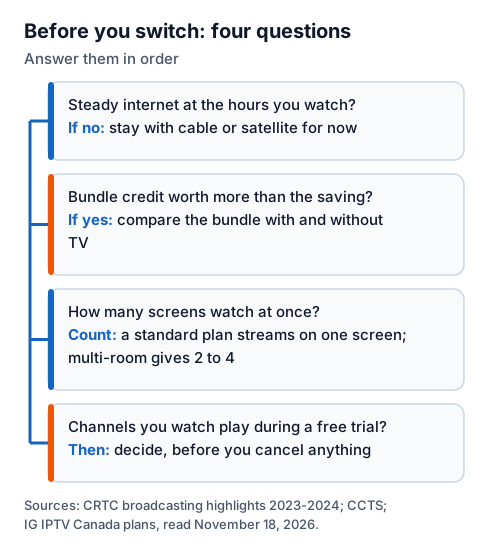
- Dependence on your internet. Live TV over the internet needs a line that stays steady at the hours you watch; our guide to stopping IPTV freezing shows how to test it.
- Bundle credits. If your TV is bundled with internet at a credit, dropping TV can change the internet price too. Compare the bundle with and without TV.
- The rights question. IPTV technology is legal; whether a particular seller's service is lawful depends on whether it holds the rights to what it streams. IG IPTV makes no claim to hold broadcast rights. Read our guide to telling legal IPTV from illegal before you choose any seller.
Who should stay with cable or satellite?
Stay put if your internet is slow or unreliable, if dropping TV would cost you a bundle credit worth more than the saving, or if the French-language or regional programming you watch is only on a package. The CRTC notes that many satellite services sit at the higher price points, likely because they are the only service available to some Canadians.
Rural households on capped or slow connections are the clearest case. Satellite costs more, but streaming live TV over a weak line will frustrate you whichever service you pick.
How can you test a switch without cancelling anything?
Run a free trial on your own TV and internet before you touch your current package. IG IPTV's trial lasts 24 hours and needs no credit card, so you can check the channels you watch, at the hours you watch them, side by side with what you have now.
Count the screens that watch at once: a standard plan streams on one screen at a time, and the multi-room upgrade gives 2 to 4 streams on one login. Picture quality goes up to 4K where the channel broadcasts it. We do not promise any channel, league or event as included, so check yours by name during the trial. The first purchase has a 7-day money-back guarantee when a service problem you report within 7 days of payment cannot be fixed; the conditions are on the IG IPTV Canada refund policy. When you are ready, start the 24-hour free trial for Canada.
Frequently Asked Questions
Are Canadians really cancelling cable?
Some are. The CRTC reports that subscribers to cable, satellite and operator IPTV packages fell by an average of 3% a year from 2020 to 2024, and cites MTM data showing nearly 30% of Canadians changed or cancelled their package in 2024. Others moved to cheaper packages.
How many Canadian households are streaming-only?
According to MTM data cited by the CRTC, 29% of Canadian households were streaming-only in 2024, up from 23% in 2023.
Is operator IPTV like Bell Fibe TV counted as cord cutting?
Not in the CRTC's figures. The CRTC counts Bell Fibe and Telus Optik TV as TV distributors alongside cable and satellite, so a move from cable to Fibe TV stays inside the distributor numbers.
Do Canadians spend more on streaming than on TV packages now?
Yes, on the CRTC's estimate. In 2024, average household spending was $34.7 a month on online video and audio services and $28.6 on TV distributors.
Is switching to IPTV cheaper than cable?
It can be. Rogers listed TV-only packages from $24.99 a month plus $20 in box and gateway fees; IG IPTV Canada costs from CA$25 a month or CA$95 for 14 months, with your own internet and device on top.
Sources
- CRTC, Communications Market Reports, highlights of the broadcasting sector 2023-2024 (subscribers, revenue, household spending, MTM data), PDF from the CRTC open data portal, read November 18, 2026
- CRTC, Communications Monitoring Report, highlights of the broadcasting sector 2019-2020 (IPTV definition and revenue growth), PDF from the CRTC open data portal, read November 18, 2026
- Rogers, Rogers Xfinity TV-only page, read November 18, 2026
- Bell, Fibe TV home page (Ontario region), read November 18, 2026
- Commission for Complaints for Telecom-television Services (CCTS), home page, read November 18, 2026
- IG IPTV Canada terms of service and refund policy, and the site's CAD price list, read November 18, 2026
Couldn't read: Statistics Canada's data tables and The Daily (statcan.gc.ca answered with a security check), so no Statistics Canada figure is quoted directly; the CRTC's own web pages (same check), so the CRTC is quoted from its report PDFs; Telus's TV pages (telus.com answered with a browser check), so Telus is named only as the CRTC names it.